Thursday, January 19, 2017

A conversation with daylily hybridizer, Lee Pickles


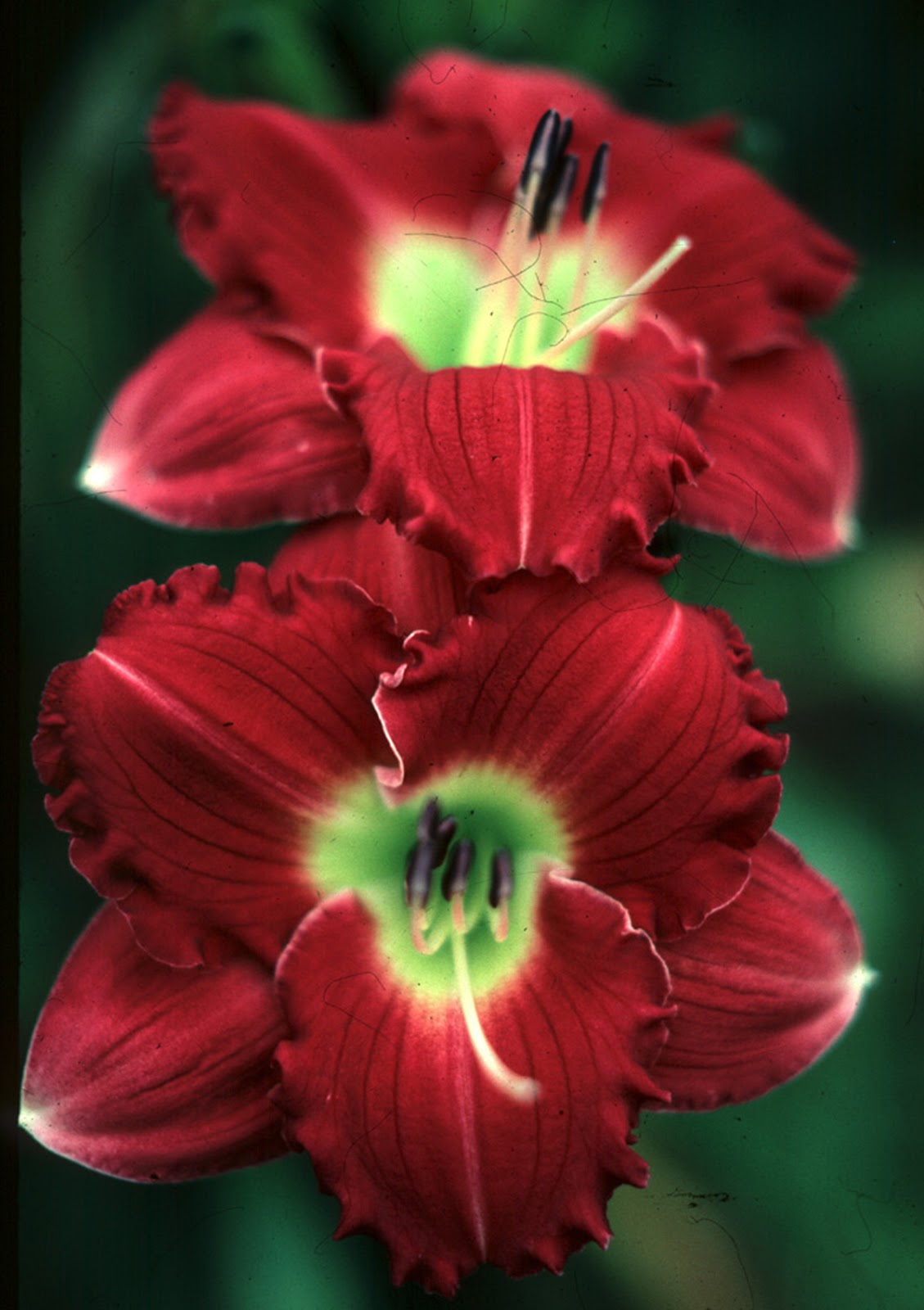
            Stolen Heart (Lee Pickles 2016) photo courtesy of Rich Howard.


            Groovin (Lee Pickles 2011) Photo courtesy of Verna Habermel.


           Seedling 5025 (Lee Pickles)  (Camelot Red X Blazing Cannons)


           Seedling 2041 (Lee Pickles)  (Stolen Heart X Barbara Mandrell)


    Having always had an admiration for red tetraploid daylilies, it is an honor to have Lee Pickles as our guest today.  I have enjoyed watching Lee's most recent developments with his advancements in red daylilies both on Facebook and on his blog.  With nothing further, here is my feature about how Lee's love of daylilies unfolded: (The first section was written by Lee Pickles.)

 My life began in Iowa on March 15th, 1936, so I will be 81 soon. (still younger than Tommy Maddox) Grew up and lived in Iowa.  Married to Jean Ivelle Manley in 1957. Graduated from Ellsworth Community College, Iowa Falls, IA in 1960, Iowa State Teachers College (now University of Northern Iowa) in 1962 with a Bachelor's Degree and Iowa State University in 1969 with a Master's Degree.  Have done further PhD work at the University of Nebraska and the University of Tennessee.

In 1962 I began teaching vocational printing at Thomas Jefferson High School in Council Bluffs, IA. In 1968 I joined Iowa Western Community College in Council Bluffs in administration.  In 1973 I was employed at the University of Nebraska Medical Center in Omaha in medical administration. In 1974 the opportunity presented itself to move to Chattanooga as Executive Assistant to the Dean of the University of Tennessee College of Medicine and Director of Continuing Medical Education.

Up to this point, I had no interest in flowers or gardening.  We purchased a house in a suburb of Chattanooga.  Jean's mother was an avid flower gardener and grew many varieties of flowers including the daylily, Hyperion, which was the first daylily we ever planted.  At the time, I had no idea there were any other colors of daylilies.

Time passed and in 1985 I happened upon a daylily show at a local mall and saw the many varieties and colors of daylilies.  I was particularly taken with H. Lullaby Baby and it all began there.


1. Which daylily hybiridizers influenced you in the beginning and which ones do now?


When I began my interest in daylilies, I met Denver Scott, a local hybridizer (hybridized the baseball named theme daylilies) at my first meeting of the Tennessee Valley Daylily Society. He began talking to me about creating my own daylilies and got me excited about hybridizing. Denver would mix all of his eyed and edged pollen together and use it to hybridize. He also did this with all others, purples, reds, yellows, etc. He was not interested in keeping parentage of crosses. Then I met Dr. C. E. (Doc) Branch
of Piper City, IL. Doc took me under his wings and shared many of his intros and cultivars from other various hybridizers with me. Doc probably had the most influence on me of all that I came into contact with. Last but not least was Dr. Bob Carr of Ocala, FL. Not only did he instruct me on hybridizing, but was a very good friend. I would visit Bob and we would sit out under his old oak tree, where he placed his potted hybridizing plants, waiting for the temperature to hit 60ยบ so he could start hybridizing. Bob would spend most of the winter planning his crosses for the following summer and would very seldom vary from those plans. We would talk almost nightly and because of his humor, do a lot of giggling. My wife said we sounded like a couple teenage girls on the phone. Bob spent the last couple months in the hospital with complications of diabetes. He called me and asked if I would send him some pictures of my seedling bloom that summer as he did not get to see any. I sent him about a dozen and after looking them called me and asked if a certain seedling panned out would I name it for him. Thus H. 'Robert W. Carr' in his memory.


2. What were your initial goals for your hybridizing? What are they today?
My original hybridizing was a shotgun approach, hybridizing most colors and patterns. Probably of those, yellows were my favorite. I have now settled on red as my major hybridizing color. In 2008, Jeff and Elizabeth Salter visited with us and spent the night on their way to the Ohio gardens. Jeff brought me a numbered seedling, he said, "To play with". At the same time I saw a red seedling of Larry Graces in the garden of Bill Waldrop. I called Larry and asked if I could purchase a piece of the seedling. He said he was not selling it yet but would guest a piece with me. I used those two seedlings which would end up being named H. 'Camelot Red (Salter), and H. 'Home of the Free' (Grace). Along the way I also acquired H. 'Doug's Caress' (Holly), and H. 'Barbara Mandrell' (Kirchhoff). All became the beginning of my red program.


3.Talk about some of the challenges you've had with your hybridizing?
I think it was 2006 or 7 that Bob Carr called me and said he did not get his 30,000 seeds that year and did I have some that I would like to send for him to plant. Of the 500 seeds that I sent, one was special and was eventually named H. 'Awesome Bob'. I was planning to introduce it in 2010 and had taken orders in the fall of 2009. Something happened that killed every plant in the greenhouse, including my new seedlings, my hybridizing plants and all of the H.'Awesome Bob' that I had taken orders for. Luckily, Bob also had a supply that I could use to fill orders. Currently my physical health has presented a challenge.


4. What are some of your favorite daylilies from other hybridizers and those of your own?


Some cultivar favorites from other hybridizers are: H. 'Camelot Red' (Salter), H. 'Home of the Free' (Grace), H. 'Barbara Mandrell' (Kirchhoff), H. ' Wonder of it All' (Carr) and H. 'Blazing Canons' Waldrop. I also like the green edges from Tommy Maddox, and the form from Bill Maryott.

Some cultivar favorites from my own hybridizing program are: H. 'Doc Branch', H. Awesome Bob', H. 'Horny Devil', H. 'Jaimie Pickles' (named for our son), H. 'Nicole Pickles' (named for our daughter in law), H. 'Stolen Heart', and from way back, diploids H. "Bonbini' and H. 'Choo Choo Caboose'.


Here are some of Lee Pickles select seedlings:  


                Seedling 4025 ( Lee Pickles)


Seedling 5033 (Lee Pickles) (Marines Hymm X Sister Valerie)


 Seedling 6037 (Lee Pickles) (Bogart X Ultimate Sacrifice)


Seedling 6062 (Lee Pickles) (Marines Hymm X Velvet Throne)
Seedling 2051 (Lee Pickles) (Desire of Nations X Bluegrass Memories)


 Seedling 3077 (Lee Pickles) (Desire of Nations X Bluegrass Memories)


Here are some of Lee Pickle's favorite introductions: 


 1. Choo Choo Caboose (Lee Pickles 1998)


               2. Doc Branch (Lee Pickles 1998)


              3. Jean Pickles (Lee Pickles 2008)


4. Horny Devil (Lee Pickles 2007) photo courtesy of Paul K. Lewis


            5. Jaimie Pickles (Lee Pickles 2016)


             6. Nicole Pickles (Lee Pickles 2016)


               7. Stolen Heart (Lee Pickles 2016)


I hope you enjoyed this visit with Lee.  Stay tuned for our next segment where I will feature northern daylily hybridizer, Karol Emmerich and some of her fantastic seedlings.  Special thanks to Lee Pickles for taking the time to answer these questions and share his photos.  If you would like to visit Lee Pickle's website, you may do so by logging on to:  http://chattanoogadaylilies.com/2017Introductions.html.  All images are the property of Lee Pickles and use without prior consent is prohibited.  Thanks for checking in folks.  


Wednesday, January 4, 2017

A conversation with daylily hybridizer, William Marchant


  Marchant seedling ((STARMANS QUEST x ROSE F KENNEDY) x 12-14)) x JUSTIFIED


                       Multi-Ring Pileup (Willaim Marchant 2017 introduction)

   
     I like to feature hybridizers that I would like to get to know better and this segment I chose the daylily hybridizer, William Marchant.  I have never met William, which is part of the reason I wanted to get to know him better, and William has been nice enough to guest some of my daylilies for the past couple years.  I love seeing his pictures of his intros and his seedlings on Facebook, so with nothing further, here is a short conversation with William Marchant:

1.How did you first get interested in daylilies?
I had just begun my first job teaching sixth grade at West Blocton Elementary School in 1994.  My principal, Sarah Lunsford, passed around the Gilbert Wild’s catalog that she had received in the mail.  Back at that time, I was struggling to make ends meet, but I just couldn’t pass up the opportunity to order some daylilies.  After all, my father had grown daylilies as long as I could remember.  I put together an order of about $75 (most of these daylilies were $2-3 each.  I really thought that I’d lost my mind.  Who in their right mind would spend $75 on daylilies?  Now, I look back and laugh since I’ve spent upwards of $500 on more than one prized cultivar.
In 1999, I bought the first new hybrid, H. Batman, from Matthew Kaskell.  Needless to say, I was hooked.  A few years later, both Sarah and I joined the West Alabama Daylily Society where Sarah served as president and I served as vice-president for several years.  For about the next five years, I purchased most of the yearly collections from several of the big named hybridizers of the day: Kaskell, Stamile, and Salter.  To support my habit, I would sell daylilies on the lily auction.  Soon, I realized that people might be interested in buying daylily seeds, so I began to list these on the lily auction in the plant section.  It wasn’t long until Mike Longo added a new section to the auction for selling seeds.
2. Which daylily hybiridizers influenced you in the beginning and which ones
do now?
The first hybridizer that I was privileged to meet was David Kirchhoff.  He was the speaker at the Region 14 meeting in Meridian, MS.  I was awestruck to say the least.  That was back when hybridizers showed their programs on the slide projector.  I just sat and watched as slide after slide of gorgeous doubles made their way onto the screen.  I loved doubles, and there is no one in the world who has done more to advance the double form.  While he would never remember me from that meeting way more than 20 years ago, it sure had
I also became very close to James Townsend and Henry Boykin who both lived in the Laurel, MS area.  I made annual trips to see both of these gentlemen, and they were generous with both advice and seedlings.  They definitely took a young 20-something under their wings.  They couldn’t have been more different.  James is a soft-spoken southern gentleman, and Henry was quick witted with a sharp tongue.  I can remember arriving at Henry’s around 8 AM, after a 2 ½ hour drive, and hearing him say, “Well, it took you long enough.  It’s almost lunch now.”  But he was always kind to me, often heating up vegetable soup for us to eat while we talked.
While I am now using mostly my own cultivars and seedlings in my program, there are still hybridizers whose cultivars I will add into my program to ensure that there are new genetics.  George Doorakian’s Rose F. Kennedy is in the background of many of my introductions and seedlings.  Heidi Douglas has a program that is very compatible to mine own, and we have traded plants over the years.  Her H. Prince Poppycock has given me several future introductions, and I have also used her H. Meme’s Lovin the Limelight a great deal.  David Kirchhoff’s double introductions still make their way into my breeding program every year.  Much of my tetraploid double program is built on his cultivars.  I also admire the fancy patterns that Bob Faulkner has developed in his lines and have incorporated several of those into my own breeding lines.  My friend, Bill Waldrop, lives about 45 minutes away.  He grows some amazing plants, many of which I have used in my tetraploid program.  He is also wonderful in accomplishing conversions.  He has converted several daylilies that I am using in breeding.  The latest hybridizer to catch my eye is Ron Reimer.  I really admire the dormancy in his lines, the breeding for rust resistance, and the plant habit of his introductions.
3. What were your initial goals for your hybridizing? What are they today?
When I first began pollen dabbing a little more than 20 years ago, I had no focus.  I was all over the place.  I just crossed everything.  I was young and thought that I really didn’t need a focus.  I was also developing the foundation of my line and several of those early seedlings are in the background of my current program.  Eventually, I realized that I had to finetune my program.
Currently, about 75% of my program is diploids.  I have a rather large program of UFs, green infused, and patterns.  I am also working on a hardy line of spidery doubles.  There is also an applique line developing.
Of the 25% of tetraploids, I am working on patterns, tones of blue, doubles (especially UF forms), and reds.
I also breed mostly for dormant foliage.  Since most of my market is from N. Georgia to Canada, my plants need to be able to withstand the climate in zones 6 and lower and thrive.
4.Talk about some of the challenges you've had with your hybridizing?
One of the first challenges that I faced was moving my entire garden from Tuscaloosa, AL to my current location in Douglasville, GA.  I had to pot up all of my plants and move them to my parent’s home.  They spent more than a year in those pots as I spent my first year in Georgia in an apartment.  After locating and purchasing a home on almost 2 acres, I was able to begin building my garden over again.
Now, my greatest challenge is space.  My garden has grown to take up about 0.75 acres of my property.  I have to select seedling in their first year of bloom so that I have space for the next year’s seed crop.  I probably compost many great plants by doing this, but if I want to begin a seed crop each year, this quick rotation is necessary.
5. What are some of your favorite daylilies from other hybridizers and those
of your own?
Some of my favorite plants from other hybridizer’s that I have used in my program are Rose F. Kennedy (Doorakian), Jeanne Rowles and Royal Carnelian (Kirchhoff), Center of the Universe (DeVito), Prince Poppycock (H. Douglas), Kaleidoscopic Intrigue (Carpenter), Wild Dreams (Grace), and Almira Buffalo Bone Jackson (Faulkner).
Some of my favorites of my own introductions are Viva Glam Girl, Blue Goblin, Leprechaun’s Curls, Live Long and Prosper, and this year’s introductions, Falling Water and Multi-ring Pileup.
Druid City Daylily Garden is located in Douglasville, GA about 25 minutes from downtown Atlanta.  While my garden sits in the middle of the town of Douglasville, we still have lots of wildlife visit the garden.  I have to continually fight off deer and have learned to make my own repellant from rotten eggs and garlic.  Owls, hawks, chipmunks, rabbits, and lots of frogs and lizards make themselves right at home.  About two years ago, I began to add some perennial borders to the property so that I could provide plenty of nectar for hummingbirds and pollen for bees.

Here are some of William Marchant's seedlings:


      Marchant seedling 15-03 (Southern Sunrise X Isabels Spider) X Seedling.


Marchant seedling 14-69 ((Live Long and Prosper X (Super Fancy Face X Kaliedoscopic Intrigue))


               Marchant seedling 15-15 (Live Long and Prosper X Feng Zhu)

 Marchant seedling 14-29((Sdlg. X Passions Promise)X Mark Allan Perry)) X Precious Stones


                   Marchant seedling (Bonibrae Sharky X Viva Glam Girl)

                            Marchant seedling (Lifes a Beach X Feng Zhu)

      Marchant 2018 future (Hotter than the 4th of July X The Mighty Goliath)
         

I asked William what some of his favorite intros were and here they are:

                                   Leprechuan Curls (William Marchant)

                                       Blue Goblin (William Marchant)


                              Live Long and Prosper (William Marchant)


                                  Red Stinger (William Marchant)


I'd like to take this opportunity to thank William Marchant for taking the time to answer my questions, and especially with all the help he has given me with helping me increase the fan count on some of my daylilies.  I really look forward to the day I can get back down to Georgia and visit William's fantastic garden.  All photographs are the property of William Marchant. You can visit William's website at http://druidcitydaylilies.blogspot.com/   I hope to feature a couple more hybridizers in the weeks to come.  Happy New Year to all my daylily friends.


Friday, December 23, 2016

Streaks, stipples, and spots. Part 2.


                                 Sunny Caldwell seedling .5 (point five)


                                        Clown Pants (Steve Todd)

     I wanted to continue my streaks, stipples, and spots segment with more tetraploid advancements in this category.  Over the past year I have witnessed in person and seen on Facebook many new very cool daylilies with this look.  I am looking forward to the future of these types of daylilies and hope to be fortunate enough to create a few of them as well.  Here are some advancements from around the country:


 Sunny Caldwell seedling .5 (point five) It sometimes has two different colored blooms from the same plant.  Amazing!  Thanks Sunny for sharing these pics!


                       Clown Pants (Steve Todd)  Awesome daylily Steve!


                         William Marchant seedling. What a unique look!


                  Chad Bush seedling. Unbelievable. What an advancement!

                                Chad Bush seedling (speckles and teeth!)

                  
                               Chad Bush seedling. Fantastic Chad!


    Wacky Wednesday (Elaine Seifert) photo courtesy of Elaine Seifert. Very nice!
               

          Wacky Wednesday (Elaine Seifert) photo courtesy of Dave Mussar.


                     Pretender (Bryant) (photo courtesy of Elaine Seifert)


            Augies Unique Beauty (Krupien) photo courtesy of Paul K. Lewis

                     Alien DNA seedling (photo courtesy of Vic Santa Lucia)


       Undefinable (Nicole DeVito) photo taken by Paul K. Lewis in his garden.

There have been some really cool advancements in the world of dots on daylilies as well.  Take a look at these pictures from Dave Mussar of Canada of some of his intros.  Fantastic Dave!


                                        Dots Galore (Dave Mussar)


                                 Spots Before my Eyes (Dave Mussar)


                                    Spots and Stripes (Dave Mussar)

Special thanks again to all of the hybridizers for sharing
 their photos.  All pictures are the property of each person and reproduction without prior consent is prohibited.  Hope you enjoyed these segments.  Here's wishing everyone has had a nice holiday season and good new year.  I've got some good segments lined up for 2017, so stay tuned.  

Sunday, December 11, 2016

Streaks, Stipples, and Spots (Part 1) Tetraploids


                Tetraploid Pink Stripes (Waldrop/Derrow)photo by Paul K. Lewis


              Explosion in the Paint Factory (Rich Howard)photo by Paul K. Lewis

      Continuing with my segment about streaked, stippled, and spotted daylilies, I wanted to show the tetraploid advancements in this category.  Some years back my friend, Bill Waldrop from Georgia did a conversion on Pink Stripes. He sent me back a fan of it last year.  Also a recent breakthrough by Rich Howard came when he introduced Explosion in the Paint Factory.  I believe Tet. Pink Stripes and Explosion in the Paint Factory will be instrumental in advancing the look of these types of daylilies.  Recent introductions from Chad Bush are starting to make break throughs there as well. Below are photos of daylilies that have this kind of look.  Enjoy the picture show:


      Master Sergeant Kenneth Lane (Bill Waldrop 2017 intro) out of Tet. Pink Stripes


      Stuart Kendig seedling (Strawberry Milkyway X Explosion in the Paint Factory)


  Stuart Kendig seedling #2 (Strawberry Milkyway X Explosion in the Paint Factory)


       Paintball Party (Angie Ridder) out of Explosion in the Paint Factory.


                                   Paintball Party (Angie Ridder)


    Explosion in the Paint Factory selfed. (Photo courtesy of Rich Howard)


                                       Bill Waldrop seedling 6-49.


     Master Segeant Kenneth Lane X Tet. Yankee Pintripes (Waldrop/Howard)


    Long Ago in a Galaxy Far Far Away (Chad Bush) photo by Paul K. Lewis


                  Long Ago in a Galaxy Far Far Away seedling (Chad Bush)


I'd like to thank all the hybridizers for their photos.  Remember these photos are the property of each hybridizer and use without prior consent is prohibited.  There are some really exciting advances going on with daylilies and these are just the tip of the iceberg. Stay tuned for part 2 on this series where I will show you some really cool photos of some new intros and seedlings in this category.


Blog Archive